Supreme Court Lawyers Detained During CJP Protest: CJI Surya Kant Seeks Release, SCBA Raises Concerns
Several lawyers were detained near the Supreme Court in Delhi on October 10 during protests demanding Chief Election Commissioner Gyanesh Kumar’s resignation, prompting the Supreme Court Bar Association to seek urgent intervention from Chief Justice of India Surya Kant.

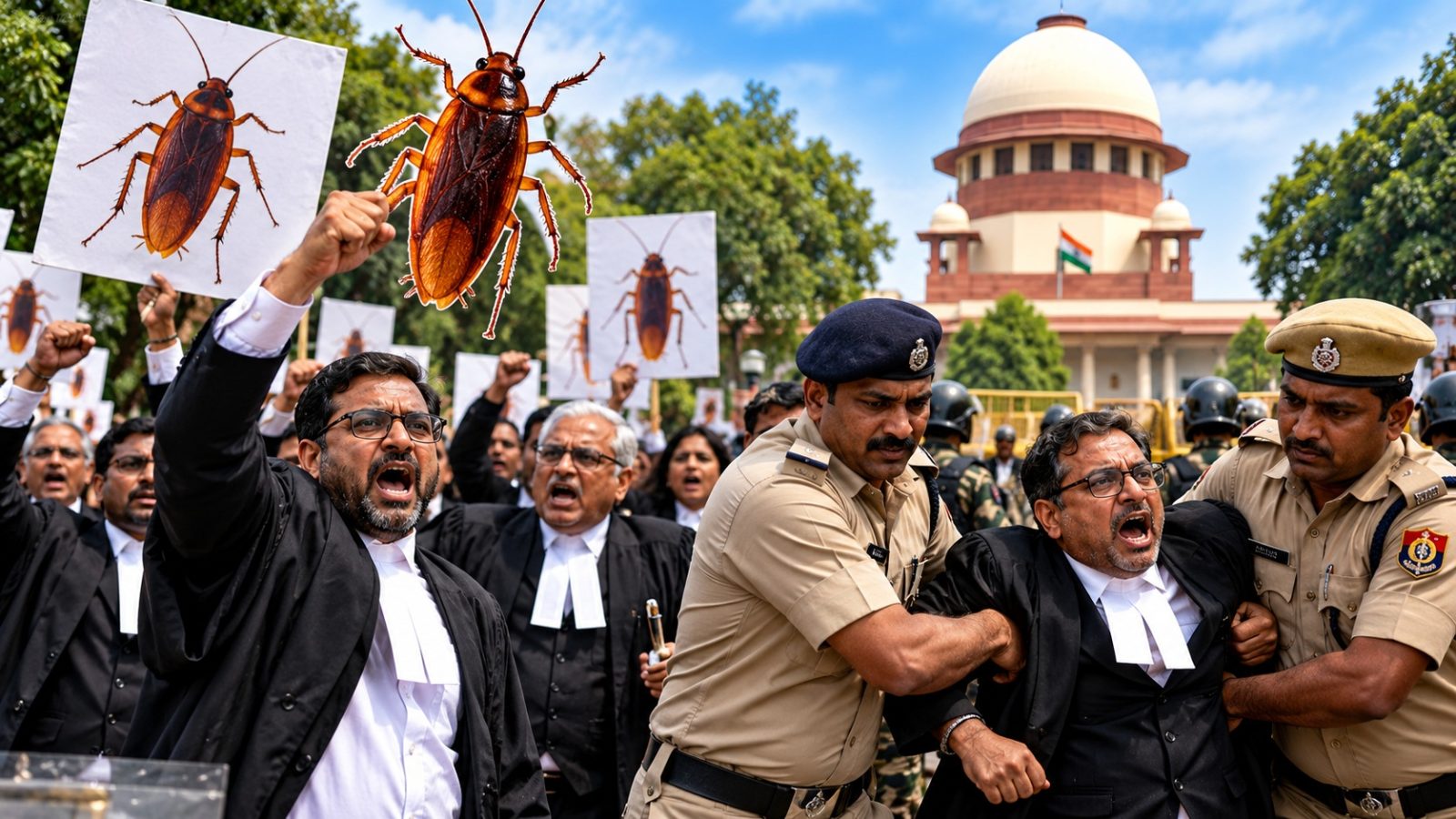
The protest against Chief Election Commissioner (CEC) Gyanesh Kumar took a new turn on Saturday, October 10, after Delhi Police and central forces detained several lawyers near the Supreme Court in New Delhi.
The lawyers were marching from the Supreme Court area towards Jantar Mantar to protest against alleged irregularities in the Election Commission's Special Intensive Revision (SIR) of electoral rolls. The protest was linked to a wider campaign led by the Cockroach Janta Party (CJP) and student and youth groups.
According to LiveLaw, the lawyers had marched for around 100 yards before police personnel stopped them and took them away in a bus. Reports said the detained group included senior advocates, younger lawyers and women lawyers, including Supreme Court advocate-on-record Sumita Hazarika.
The Supreme Court Bar Association (SCBA) raised concerns about the detentions and called on Chief Justice of India (CJI) Surya Kant to intervene. Media reports later said the CJI asked the authorities to ensure the release of the detained lawyers.
The episode has brought renewed attention to the balance between maintaining public order and allowing people to express their views peacefully.
What Did the Supreme Court Bar Association Say?
The SCBA, which represents lawyers practising before the Supreme Court, expressed serious concern over the reported police action.
In a resolution dated October 10, the association said it had received information that several advocates had been detained during the protest. It raised particular concerns about the reported treatment of women lawyers and the alleged use of excessive force.
The association asked CJI Surya Kant to take up the matter urgently with the concerned authorities, establish the whereabouts of the detained advocates and ensure their safety.
It also called for an examination of the alleged police action and appropriate steps in accordance with the law.
SCBA president Pradeep Rai publicly raised the issue and said he had spoken to the Deputy Commissioner of Police for New Delhi. He subsequently stated that the detained lawyers would be released immediately.
The association's concerns were based on reports it had received about the incident. Allegations regarding the treatment of individual lawyers require proper examination, and the available reports do not establish that every allegation has been independently verified.
What Did CJI Surya Kant Do?
Reports from October 10 said that CJI Surya Kant asked the authorities to release the lawyers detained during the protest.
The development followed the SCBA's appeal for urgent intervention and its concerns about the lawyers' safety and treatment.
The reported intervention is significant because the incident involved advocates protesting close to the Supreme Court itself. It also highlights the role of the judiciary and legal institutions in responding to concerns about the treatment of people detained during public demonstrations.
However, the reported direction concerning the lawyers' release should be understood separately from the wider dispute over the protest. It does not, by itself, settle the allegations surrounding the police action or the protesters' claims about the electoral-roll revision process.
Why Were the Lawyers Protesting?
The lawyers were protesting against the Election Commission's Special Intensive Revision, commonly known as SIR, of electoral rolls.
The SIR process involves a detailed review of voter lists to check whether entries are accurate and eligible voters are properly included. Electoral-roll revisions can involve checking voter details, removing duplicate or ineligible entries and updating records when people move, die or otherwise become ineligible.
Protesters have alleged that the process could lead to eligible voters being removed from electoral rolls. They have demanded greater accountability from the Election Commission and called for CEC Gyanesh Kumar's resignation.
The Election Commission's stated purpose in conducting electoral-roll revisions is to improve the accuracy of voter lists. Claims about wrongful deletions, however, need to be assessed using official records, the applicable revision process and evidence from affected voters.
It is important to distinguish between an allegation that eligible voters may be removed and a verified finding that such removals have taken place on a particular scale.
The protest is therefore not only about the position of the Chief Election Commissioner. It also concerns public confidence in the preparation of voter lists and the process through which citizens can challenge errors.
What Is the Cockroach Janta Party?
The Cockroach Janta Party, or CJP, is a protest group that has organised demonstrations on issues including examination paper leaks and electoral concerns.
For the October 10 protest, the group and other participating organisations called for a demonstration at Jantar Mantar, with the resignation of CEC Gyanesh Kumar among their main demands.
CJP leaders Abhijeet Dipke, Saurav Das and Ashutosh Ranka were also detained by Delhi Police after arriving at Indira Gandhi International Airport from Mumbai, according to reports.
A video shared by the party showed Dipke telling police officers that the leaders had come to Delhi prepared to be arrested. The party condemned the detentions and claimed that its leaders were being prevented from reaching the protest venue.
These statements represent the position of the protest organisers. The police's reasons for individual detentions and the legal basis for each action need to be assessed separately.
The lawyers' march near the Supreme Court was another part of the wider protest activity taking place in the capital that day.
Why Did Delhi Police Refuse Permission for the Jantar Mantar Protest?
Delhi Police had refused permission for the proposed CJP demonstration at Jantar Mantar. Reports cited concerns about law and order and the timing of the permission application.
Authorities introduced extensive security measures in New Delhi ahead of the planned protest. These included police deployment, barricades and restrictions affecting movement in parts of the capital.
The administration's challenge was to manage a large planned demonstration while preventing possible disorder and limiting disruption to public life.
However, the scale of the restrictions itself became a subject of legal scrutiny.
On October 9, the Supreme Court expressed concern about proposals to close a large number of Delhi Metro stations and restrict long-distance train services ahead of the demonstration. The bench led by CJI Surya Kant said that an entire city could not be shut down to manage a protest and stressed the need for proportionate security measures.
The Court recorded the government's assurance that authorities would reconsider the restrictions and regulate transport in a way that reduced inconvenience to the public.
This was an important distinction: security arrangements may be necessary, but they must also account for the everyday needs of commuters, workers, students and other residents.
Were Around 100 Lawyers Detained?
Several news reports described a large group of lawyers being detained near the Supreme Court. Some reports cited a figure of around 100 advocates, while other reports referred more generally to several detained lawyers.
The exact number should therefore be treated with caution unless confirmed through an official statement or a complete, independently verified account.
The SCBA's immediate concern was that advocates had reportedly been taken away and that their whereabouts and safety needed to be established. The association called for their release and for the alleged use of excessive force to be examined.
Advocate-on-record Sumita Hazarika was among those identified in media coverage. She reportedly told Bar and Bench that some women lawyers had been mistreated and taken away in a police vehicle used for transporting detainees.
These are serious allegations. A proper assessment would require accounts from the affected lawyers, police records, available video evidence and any official explanation of the detentions.
What Does the Incident Mean for the Right to Protest?
India's Constitution protects freedom of speech and peaceful assembly, subject to reasonable restrictions permitted by law.
This means people can express disagreement with public institutions and organise peaceful demonstrations, but authorities may impose lawful restrictions to protect public order and safety.
The important question in such cases is whether restrictions and police action are lawful, necessary and proportionate to the situation.
A protest organiser's demand for a demonstration does not automatically remove the authorities' responsibility to manage public safety. Equally, the need for security does not mean that every restriction or detention is automatically justified.
The Supreme Court's October 9 observations about transport restrictions and the SCBA's concerns on October 10 raise related but separate issues: how the administration manages a planned protest, and how individual protesters and lawyers are treated during enforcement.
Both questions require attention to the facts, applicable law and the reasons given by the authorities.
Why Is the SIR Controversy Important for Voters?
Electoral rolls determine who is listed as eligible to vote. Errors can have serious consequences for citizens, particularly if an eligible voter discovers that their name is missing close to an election.
At the same time, accurate voter lists are important to prevent duplicate entries and ensure that only eligible people are registered.
The purpose of a revision process is therefore important, but so are the safeguards used to carry it out. Voters need clear information about how to check their registration, correct mistakes and appeal decisions where the rules allow.
Claims of large-scale wrongful deletion should be examined through verifiable data, including official figures, the number of objections and appeals, and the outcomes of those appeals.
For ordinary voters, the practical step is to check their names and details on the official Election Commission voter services platforms and follow the prescribed process if any correction is required.
What Happens Next?
The immediate developments concern the release and treatment of the detained lawyers, the SCBA's request for an examination of the alleged police action and the wider dispute over the proposed CJP protest.
The political demand for CEC Gyanesh Kumar's resignation remains separate from the question of whether the detentions were legally justified.
The controversy may also keep attention focused on how electoral-roll revisions are conducted and how authorities respond when citizens raise concerns about voter registration.
Further clarity will depend on official statements, any available records of the detentions, the outcome of the SCBA's intervention and subsequent legal proceedings.
The Bigger Picture: Security, Accountability and Public Confidence
The detention of lawyers near the Supreme Court has added a new dimension to the CJP-led protest over SIR and the demand for the CEC's resignation.
The SCBA has raised concerns about the reported use of force and asked CJI Surya Kant to intervene. Reports said the CJI sought the release of the detained advocates, while the Supreme Court had already questioned the proportionality of broad transport restrictions ahead of the protest.
The allegations about the treatment of lawyers need to be examined on the evidence. Likewise, claims about electoral-roll irregularities require verifiable information rather than political assertions alone.
The takeaway: The incident raises two important questions for public institutions: how to maintain law and order without imposing unnecessary restrictions, and how to ensure that concerns about voter lists are answered through transparent, evidence-based procedures.
- LiveLaw — Lawyers Holding Protest March Against CEC & SIR Detained in Delhi, October 10, 2026.
- https://www.livelaw.in/amp/top-stories/lawyers-holding-protest-march-against-cec-sir-detained-in-delhi-554026
- India Today — Supreme Court Lawyers Detained in Delhi Protest, Bar Chief Seeks CJI Intervention, October 10, 2026.
- https://www.indiatoday.in/amp/india/story/supreme-court-lawyers-detained-delhi-scba-seeks-cji-intervention-3013958-2026-10-10
- Moneycontrol — SCBA Urges CJI Surya Kant to Urgently Intervene in Detention of Lawyers During Delhi CJP Protest, October 10, 2026.
- https://www.moneycontrol.com/news/india/scba-urges-cji-kant-to-urgently-intervene-in-detention-of-lawyers-during-delhi-cjp-protest-14049010.html
- The Times of India — Supreme Court Asks Authorities to Release Lawyers Detained Over CJP Protest, October 10, 2026.
- https://timesofindia.indiatimes.com/india/supreme-court-asks-authorities-to-release-lawyers-detained-over-cjp-protest/articleshow/134849708.cms
- Bar and Bench — Delhi CJP Protests: Supreme Court Says No to Complete Closure of Delhi Metro or Total Blockade of Roads, October 9, 2026.
- https://www.barandbench.com/news/delhi-cjp-protests-supreme-court-says-no-to-complete-closure-of-delhi-metro-or-total-blockade-of-roads
- Reuters — India Detains Youth Protest Leader to Defuse Rally Against Election Chief, October 10, 2026.
- https://www.reuters.com/world/india/delhi-sealed-off-ahead-youth-protest-against-indian-election-chief-2026-10-10/
Report a mistake
Related stories
India Bloc Rally at Ramlila Maidan Today: Can Opposition Turn Its Campaign Against Election Commission into Mass Support?
SC Notice to Centre on Privacy Law as News Publishers Warn It Could Shut Newsrooms
Kharge Calls for November 1 Rally to ‘Save Votes, Save the Nation’
Reader comments (0)
No comments yet. Be the first.