“Badr” Agreement : A New Emerging Strategic Challenge before India’s Security
Pakistan, Türkiye, Qatar and Indonesia have signed the Badr defence cooperation agreement. What does it involve, how is it different from the Mecca Agreement, and what should India watch out for?
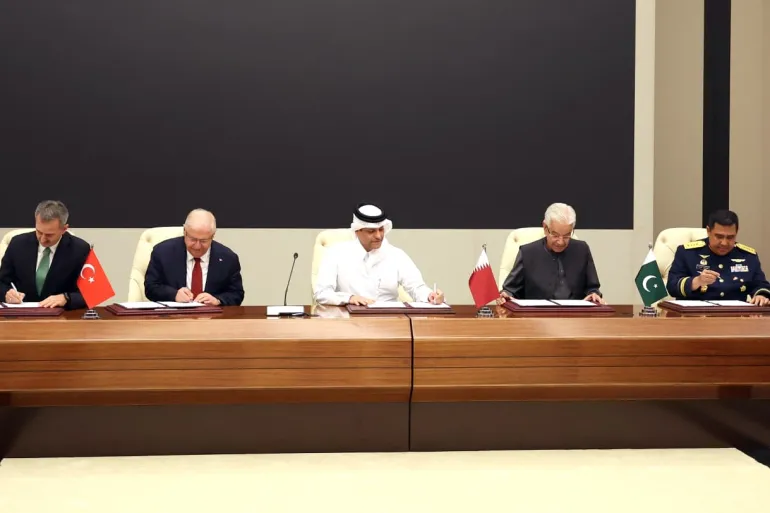
Badr agreement aims to improve military training, technology, and defense production cooperation between four nations namely Indonesia, Qatar, Turkiye, and Pakistan. Will India's security be impacted though by the Badr agreement? Let’s understand the distinctions between the Mecca and Badr Agreements and India's upcoming challenges. These four nations signed a defence agreement in Doha, the capital of Qatar on 21 October 2026, known as the Badr Agreement. As a part of agreement, the signatory countries emphasize cooperation in joint military exercises, training programme, and defence research.
It aims to strengthen the defence manufacturing capabilities of each country, facilitate the exchange of technical expertise, and promote indigenous defence production. In this regard, collaboration on defense equipment such as armoured vehicles and unmanned aerial systems (drones) is part of Turkiye's current defense partnership with Qatar.
Furthermore, this collaboration is important for fulfilling the defense needs of allies and friendly states. The development of an inclusive framework for defense production, technological innovation, and industrial cooperation in which participating nations are not required to be bound by any mutual defense commitment for cooperation. Thus, this framework can serve as catalyst for boosting self-reliance in the defense sector, strengthening strategic partnerships, and broadening regional security cooperation.
Difference between Badr agreement and Mecca agreement
In August 2026, Saudi Arabia, Pakistan, and Turkiye reached an agreement known as the Mecca Agreement shared security commitments are mentioned in the agreement. In the event of an armed attack on any one of the three nations, agreement provides for a collective security response. However, Saudi Arabia is not a member of the Badr agreement, it includes Indonesia and Qatar, and cooperation in the defense sector, military training, and research are its main priorities while the Badr agreement concentrates on improving collaboration in defense capabilities and production, the Mecca agreement deals with collective defense and deterrence. It would be inaccurate to regard both as belonging to the same military alliance. Countries in the region are establishing new networks of partnerships through these accords.
This deal could change the defense dynamics from West Asia to Southeast Asia in the near future. According to Turkiye’s defense ministry, the main objective of this agreement is to increase the mutual collaboration of four nations in the field of defense production, military capabilities, technical training, and research and development. Issue goes beyond simply purchasing weapons from other nations but to bolstering one's own defense production capabilities. Using their individual industrial and technical capacities, the four nations seek to investigate new opportunities for collaboration addressing this agreement, however no public pronouncement has been issued regarding the responsibility of all nations to engage war in the event of an attack on any nation, the collaborative manufacturing of any specific weapon system, or military deployment. Thus for the time being, it should only be seen as “defense cooperation”.
Retired major general Anuj Mathur believes that the four countries Pakistan, Turkey, Qatar, and Indonesia will cooperate with each other in weapons research and the development of new technologies. The underlying objective of this agreement is to lessen reliance on other nations, improve their own capacities, and support one another military training. However, Sanjeev Srivastava, an expert of foreign affairs firmly advocated that India must continue to exercise extreme caution, it is impossible to overlook Turkiye, which is working to become the head of the Muslim world. At the same time, the Middle East has come to the realization that their defense will be stronger the more autonomous they become.
Strategic Interests of the Four Countries Involved in the Badr Agreement: An Analysis
Badr agreement's signatory nations Pakistan, Tukiye, Qatar, and Indonesia have taken a significant step in strengthening defense cooperation. These four nations have different national interests, strategic priorities, and foreign policy goals, notwithstanding their desire to work within a framework of common defense cooperation. Expanding its defense sector, encouraging the export of military technologies, and bolstering its strategic position internationally are the main goals of Turkiye's involvement. Turkiye may look to expand into new markets, create collaborative production initiatives, and form enduring alliances in the defense technology sector by working with Pakistan, Qatar, and Indonesia.
For Pakistan this deal is significant primarily because it offers opportunities for military modernization, Indigenous defense production, and technical collaboration. Capabilities of Pakistan's local defense industry can also be improved through collaborative research and development and technology transfer. Pakistan may be effective in bolstering its defense capabilities within the framework of long-standing strategic competitive relations with India.
Expansion of foreign ties and the strategic use of Qatar's economic resources can be utilized to understand its involvement. It may attempt to invest in collaborative projects, expand access to defense technologies, and expedite the growth of its defense industry under this agreement. Additionally, Qatar may be able to broaden its diplomatic and security ties in an array of areas through collaboration with Turkey, Pakistan, and Indonesia.
Potential for military modernization, the growth of the domestic defense sector, and the enhancement of maritime security are the primary draws of this agreement for Indonesia. As a large archipelago country, Indonesia places a special focus on strengthening naval capabilities, safeguarding maritime routes, and conducting maritime surveillance.
Potential threat to India
-Sensitive information about Brahmos may leak as a result of Indonesia's participation in the Badr Agreement.
-The potential for missile technology to reach Pakistan.
-Concern over the potential impact on India's strategic position.
-Pakistan's weapon-making capacity could increase.
-Turkey's defense technologies could be advantageous to Pakistan.
-Other nations might help Pakistan manufacture weapons.
-The region may see a surge in the arms race and military rivalry.
-Its actual strategic implications should be assessed on the basis of the implementation of the agreement, the transfer of defence technology, and the future decisions of the member countries.
Report a mistake
Related stories
20-Year-Old Co-Pilot’s Mayday Calls Before Fatal Florida Plane Crash Revealed
Israel Election Deadlock: Netanyahu Leads as Opposition Closes Gap
UAE Honours flydubai Crew for Courage During September In-Flight Incident

Reader comments (0)
No comments yet. Be the first.