Supreme Court Panel Launches Portal for Complaints Over July Violence at Jantar Mantar
A Supreme Court-appointed committee has opened an online portal for complaints about July 2026 violence at Jantar Mantar and other locations, with priority for allegations involving pellet guns, violence against women and excessive force.

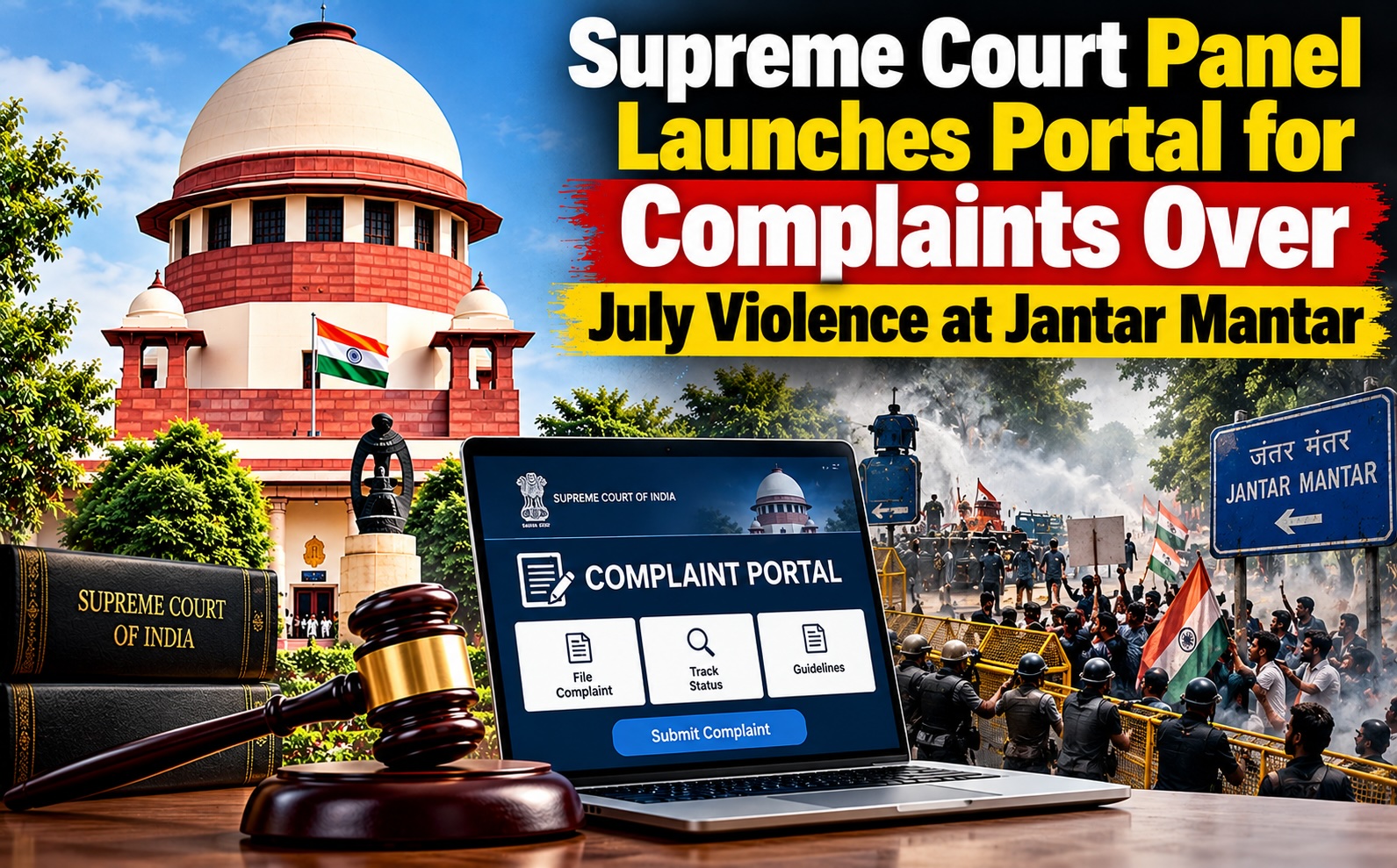
A High Powered Enquiry Committee (HPEC), appointed by the Supreme Court of India, has launched an online portal to receive complaints, representations and evidence related to violent incidents at Delhi's Jantar Mantar and other places outside the national capital during July 2026.
The portal, hpec.nic.in, is intended to make it easier for people affected by the incidents to share their experiences with the committee. This includes protesters, police personnel, other affected people and witnesses who may have information relevant to the inquiry.
The Ministry of Home Affairs (MHA) announced the launch on October 17, 2026.
The committee will give priority to complaints concerning the use of pellet guns, targeted violence, harassment of women protesters, excessive use of force and destruction of property by either side.
The launch of the portal is an important step in collecting information about what happened. However, it does not mean that the allegations have already been proved or that the committee has reached a final conclusion.
Why has the Supreme Court appointed an enquiry committee?
Violent incidents were reported during protests at Jantar Mantar in Delhi and at other locations outside the capital in July 2026.
The protests and the clashes that followed raised questions about the conduct of protesters, the response of the police and other security personnel, and the extent of damage and injuries suffered by people on both sides.
The Supreme Court appointed the HPEC to examine the incidents and the related issues. Its inquiry is based on the issues identified in paragraphs 12 and 13 of the Court's order dated August 18, 2026, and paragraph 5(i) of its order dated September 10, 2026.
Rather than relying only on reports or statements already available, the committee is inviting affected people and other stakeholders to submit their own accounts and supporting material.
This can help the committee examine different versions of events, identify evidence that needs further verification and consider whether any person or authority acted improperly.
Which issues will the committee investigate first?
The Ministry of Home Affairs has identified several priority areas.
1. Alleged use of pellet guns
The committee will examine matters relating to the use of pellet guns during the incidents.
Pellet guns can cause serious injuries, particularly when used against people at close range or in ways that put vulnerable parts of the body at risk. The inquiry can consider complaints about their use and the circumstances in which they were deployed.
The announcement does not establish that every allegation concerning pellet guns is true. The committee will need to examine the available evidence.
2. Targeted violence
The committee will also examine allegations of violence directed at particular individuals or groups.
Targeted violence may involve a person being singled out rather than being injured as part of a general clash. Witness statements, photographs, videos and medical records may help investigators understand what happened and whether particular individuals were deliberately targeted.
3. Harassment of women protesters
Allegations of harassment involving women protesters have been given priority.
Such complaints may require special care because victims and witnesses can face fear, embarrassment, social pressure or the risk of further harassment when reporting what happened.
The committee's portal has been designed to provide safeguards for vulnerable witnesses and allow affected people to request that their identities remain confidential.
4. Excessive force and destruction of property
The inquiry will also consider allegations of excessive violence and property destruction by either side.
This is significant because the committee's stated scope is not limited to complaints against the police or against protesters alone. It is expected to examine the relevant incidents from both sides.
The evidence will need to establish what happened in each case, who was involved and whether the conduct was lawful.
Who can submit a complaint?
The portal is open to people who were directly affected by the July incidents as well as other stakeholders who have relevant information.
This includes:
Protesters who say they were injured or mistreated.
Police personnel and other security personnel who were injured or affected.
Women who experienced harassment or other forms of alleged abuse.
Witnesses who saw the incidents or have relevant evidence.
People who have information or suggestions relating to the issues referred to the committee.
A person does not necessarily have to be the direct victim to provide relevant information. However, submissions should relate to the matters that the Supreme Court has referred to the HPEC.
How can people submit complaints?
Affected people can use the committee's official portal at https://hpec.nic.in.
The Ministry of Home Affairs has encouraged users to submit complaints and representations using the applicable formats available for this purpose. People can also upload relevant supporting material.
Those who do not wish to submit their material online have other options.
Online: Visit hpec.nic.in and follow the instructions for the relevant category of complaint or information.
In person: Submit complaints, representations and relevant material at the HPEC office at Shiksha Sadan, 17, Rouse Avenue Institutional Area, New Delhi – 110002.
Office hours for physical submissions: Between 2 pm and 4 pm on working days.
By post: Send the material to the same office address.
By email: hpec2026.enquiry@nic.in
Anyone wishing to provide information or suggestions relating to the issues covered by the Supreme Court's orders can also use the portal.
People submitting material should provide accurate information and preserve any relevant supporting evidence, such as photographs, videos, medical documents or other records, where available.
Will complainants' identities remain secret?
The Ministry of Home Affairs has said the portal has been designed to protect vulnerable witnesses and allow affected people to keep their identities confidential and undisclosed if they wish.
This is important because some people may hesitate to report alleged violence if they fear retaliation, social pressure or further harassment.
Women who report harassment and witnesses who may have seen serious incidents can be particularly vulnerable.
Confidentiality arrangements can help people come forward with information that might otherwise remain unreported.
However, anyone submitting a complaint should carefully read the portal's instructions about confidentiality and the handling of personal information. The government has announced that safeguards are intended to be provided, but complainants should follow the official process rather than assume that every form of submission is automatically anonymous.
What happens after a complaint is submitted?
The portal provides a channel for the committee to collect complaints, representations and relevant information. The committee can then examine submissions as part of its wider inquiry.
A complaint is an account of an alleged incident; it is not, by itself, proof that the allegation is correct.
The committee will need to assess the material available to it, compare different accounts where necessary and consider whether further examination is required.
For example, a complaint about alleged excessive force could be assessed alongside medical records, videos, witness accounts and other relevant evidence. A complaint about property damage could be examined against photographs, records of the incident and accounts from people present.
The precise findings will depend on the evidence and the committee's mandate under the Supreme Court's orders.
The Ministry's announcement does not specify a deadline for submitting complaints. Anyone wishing to participate should check the official portal for current instructions and any subsequent notices.
Does launching the portal mean someone has been found guilty?
No. The portal is part of an enquiry process, not a court judgment on individual responsibility.
The committee's task is to examine the incidents and the issues referred to it. Allegations against protesters, police personnel or other individuals must be assessed on the evidence.
The launch of the portal does not establish that the police used excessive force in every reported case. Nor does it establish that protesters were responsible for every incident of violence or property damage.
A fair inquiry must distinguish between allegations, evidence and findings.
If the committee identifies evidence of wrongdoing, any further action will depend on its findings, the Supreme Court's directions and the applicable legal process.
Why is this inquiry important?
When violence occurs during a protest, different people can have very different accounts of what happened. Protesters may allege that force was used against them unlawfully, while police personnel may report being attacked or injured. Other people may suffer property damage or witness incidents without being directly involved.
An independent examination of available evidence can help establish a clearer record of events.
The inquiry is also important because it covers sensitive issues, including the use of weapons, alleged harassment of women and possible excessive force. These matters require careful investigation rather than conclusions based only on claims made by one side.
The complaint portal gives affected people a formal way to share information with a committee appointed by the country's highest court.
Its effectiveness will depend on whether people can submit their accounts safely, whether the information is properly examined and whether the inquiry ultimately produces credible findings.
The bottom line: The Supreme Court-appointed committee has opened a portal for complaints about the July 2026 violence at Jantar Mantar and other locations. Victims, police personnel, witnesses and other people with relevant information can submit material online, by email, by post or in person. The aim is to examine allegations fairly and establish what happened based on evidence.
Report a mistake
Related stories
SC Notice to Centre on Privacy Law as News Publishers Warn It Could Shut Newsrooms

K Annamalai Questions Centre Over CJP Protest Crackdown, Jantar Mantar Ban and Police Action

Delhi Police Transfers Second Case Against CJP Leaders to Crime Branch

Reader comments (0)
No comments yet. Be the first.