Supreme Court Says Internet Access Is a Fundamental Right for Children: What the Ruling Means
The Supreme Court has recognised internet access as a fundamental right for children of all ages, saying online safety cannot justify a blanket ban. It called for stronger safeguards against abuse.

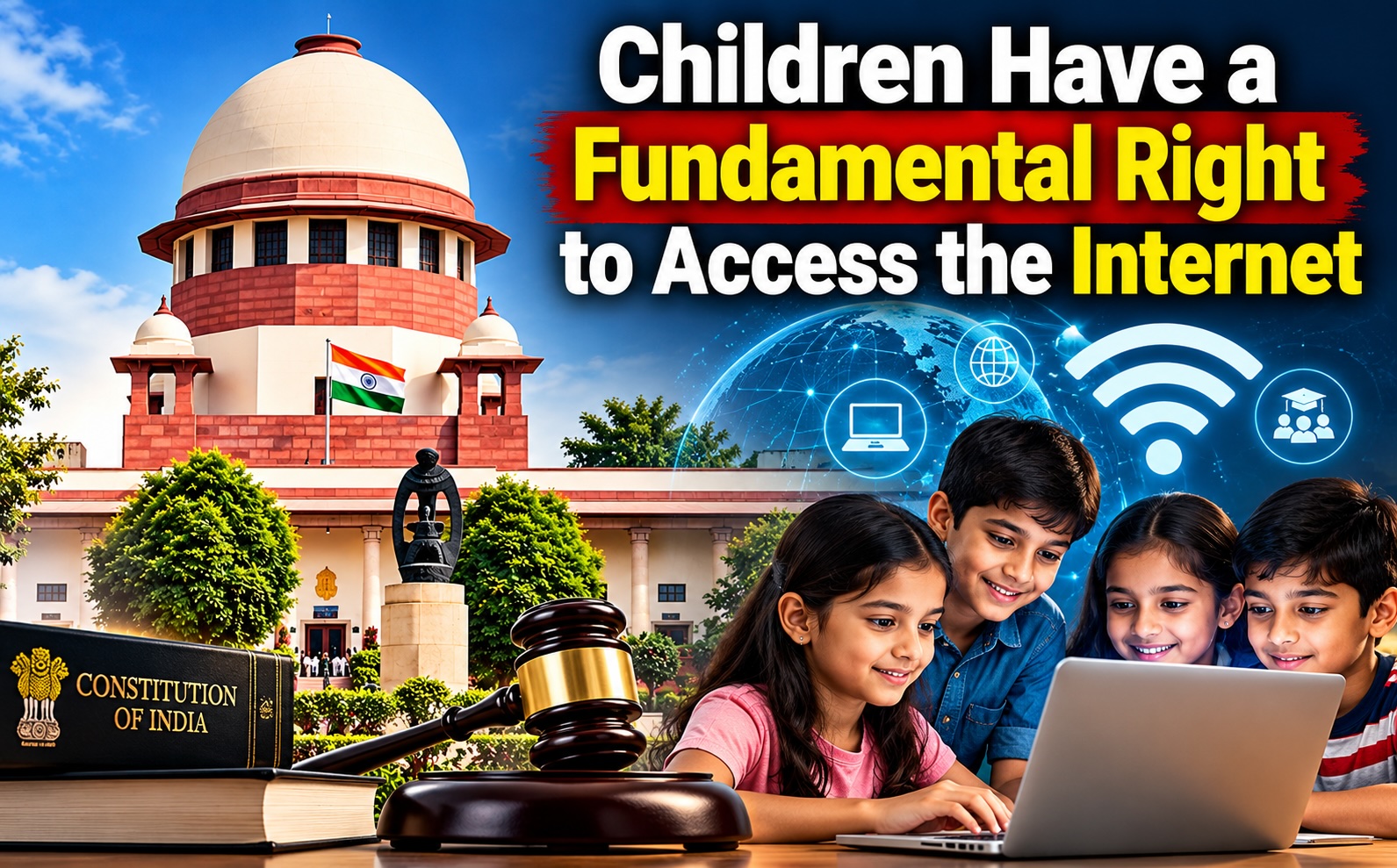
The Supreme Court of India has held that every individual, including children, has a fundamental right to access and use the internet.
In an important order dated October 15, 2026, a Bench of Justices J.B. Pardiwala and K. Vinod Chandran said children cannot be denied internet access altogether in the name of protecting them from online dangers.
The Court made these observations while hearing a case concerning the prevention and removal of Child Sexual Exploitation and Abuse Material (CSEAM) from online platforms.
The judges explained that protecting children and allowing them to exercise their freedom are not opposing goals. Children need both safety and access to information.
The ruling is significant because the internet is no longer used only for entertainment. It has become an important part of education, communication, access to information and participation in society.
However, the judgment does not mean that children can access every website without restrictions. The Court recognised that age-appropriate safeguards are necessary to protect them from harmful content and online abuse.
Which constitutional rights protect children's internet access?
The Court linked the right to access and use the internet to two important provisions of the Indian Constitution.
Article 21 — Right to life and personal liberty
Article 21 protects the right to life and personal liberty. Courts have interpreted this right broadly to include conditions necessary for people to live with dignity.
In today's digital world, access to online information, educational resources and digital services can be important to a person's development and participation in society.
The Supreme Court's ruling recognises internet access as a fundamental right under Article 21, read together with Article 19(1)(a).
Article 19(1)(a) — Freedom of speech and expression
This provision protects the right to freedom of speech and expression for Indian citizens.
Freedom of expression is not limited to speaking in public or writing in newspapers. It also includes the ability to receive information and ideas and to express one's views through different means.
The internet has become one of the main ways people learn about the world, communicate and express themselves. For children, it can provide access to lessons, books, educational videos and information that may not be readily available in their local communities.
By connecting internet access with these constitutional protections, the Court has recognised the importance of digital access in modern life.
Why did the Court reject a blanket ban on children using the internet?
The Court examined whether keeping children away from the internet altogether would be an effective way to protect them from sexual exploitation and other online dangers.
It concluded that a complete ban would not solve the underlying problem.
The judges noted that children may continue using the internet even when rules prohibit them from doing so. If they are pushed away from mainstream platforms, they may turn to less regulated websites and services where the risks could be greater.
A blanket ban could also make children afraid to report online threats.
For example, imagine a child who receives threatening messages from an adult online. If the child believes they will be punished for using the internet against family rules, they may hide the incident instead of asking a parent, teacher or another trusted adult for help.
This could allow an offender to continue threatening or exploiting the child.
The Court's reasoning is that safety measures should focus on preventing abuse, removing harmful material and holding offenders accountable, rather than treating internet access itself as the problem.
Who is responsible for online child abuse?
The Court made an important distinction between children who may be exposed to harmful material and the people responsible for creating or spreading it.
Responsibility may lie with people who create, circulate, sell or deliberately seek out child sexual exploitation and abuse material. Online platforms and other intermediaries may also have responsibilities to detect and remove such material in accordance with applicable law.
The Court's approach is that children should not lose access to an important source of learning and information because technology companies or authorities have failed to address harmful content effectively.
This does not mean children are free from all online risks, or that platforms are automatically guilty whenever harmful material appears. Legal responsibility depends on the relevant law and facts.
The broader message is that protecting children requires effective action against abuse and better systems for preventing harmful material from circulating.
Does the ruling mean children can use social media without parental supervision?
No. The Court did not say that children should be allowed to use every online service without supervision or restrictions.
It acknowledged that children need special protection online and suggested several possible safeguards.
These include:
Parental consent and guidance: Parents should have an appropriate role in helping younger children use social media safely.
A dedicated child mode: Platforms could offer special account settings designed for children.
Private accounts by default: Children's profiles could automatically be private, reducing the amount of personal information visible to strangers.
Restrictions on unknown adults: Platforms could limit messages and contact from unfamiliar adults.
Better content moderation: Advertising and other content shown to children should be moderated to reduce exposure to harmful material.
Digital safety education: Children should learn how to recognise dangerous behaviour, protect their personal information and seek help when something goes wrong.
The Court left the details of implementing such safeguards to the Union Government.
These suggestions are intended to make internet use safer without denying children access altogether.
Can the government still restrict certain websites?
Yes. The Court clarified that its ruling does not prevent the government from restricting children's access to particular categories of content or services that are inherently harmful to them, such as adult-content websites.
This distinction is important.
The Court opposed a blanket denial of internet access, not every form of restriction. A targeted restriction on harmful content is different from a rule that prevents children from accessing the internet as a whole.
In simple terms, children may have a fundamental right to use the internet, but that does not create an unlimited right to view every kind of content or use every online service without safeguards.
Any restrictions must be assessed in the context of the applicable law and constitutional principles.
What action has the Supreme Court called for against child sexual abuse material?
Alongside its observations on children's rights, the Court issued directions aimed at strengthening the detection and removal of child sexual exploitation and abuse material online.
It asked the Union Government to inform it about the technological tools used by online intermediaries to identify and remove such material, as well as the feasibility of deploying these tools across the industry.
The Court also directed the creation of a comprehensive national database to help identify such material and support its removal across platforms.
Such systems can help authorised agencies and technology companies recognise known abusive material and respond more effectively when it appears online. Their operation must still follow applicable law and appropriate safeguards.
The wider objective is to make it harder for offenders to create, distribute or circulate material involving the sexual exploitation and abuse of children.
The ruling therefore addresses both sides of the issue: children's right to access the internet and the need for stronger measures against people who misuse it.
How is this different from earlier Supreme Court rulings?
The latest order builds on earlier decisions concerning digital access and constitutional freedoms.
In Anuradha Bhasin v. Union of India (2020), the Supreme Court recognised that freedom of speech and expression, as well as the freedom to carry on trade or business, could be exercised through the internet and were constitutionally protected.
However, that judgment did not finally decide whether access to the internet, by itself, was a fundamental right.
In Pragya Prasun v. Union of India (2025), the Court recognised digital access as an important part of the right to life under Article 21 and stressed the need for inclusive digital systems.
The October 2026 order takes the issue further by expressly recognising the right to access and use the internet as a fundamental right of every individual, including children.
It also makes clear that children should not be excluded from the digital world simply because the internet can be misused.
Why is this ruling important for ordinary Indian families?
For many Indian families, the internet is now part of everyday life. Children use it to attend online classes, prepare for examinations, learn new skills, read about current affairs and communicate with teachers and classmates.
For children in remote areas, online resources can sometimes be the easiest or only practical way to access particular educational materials. The Court also noted that the internet can help children with special needs find information and connect with others who share similar experiences.
At the same time, parents have genuine concerns about cyberbullying, inappropriate content, online grooming, sexual exploitation, scams and excessive use of social media.
The judgment does not ask parents to ignore these dangers. Instead, it supports an approach in which children are protected through supervision, education, safer technology and effective enforcement.
For families, this means that conversations about online safety are important. Children should know that they can tell a trusted adult if someone threatens them, asks for inappropriate photographs, requests personal information or tries to manipulate them online.
They should not feel that asking for help will automatically lead to punishment for using the internet.
What does the ruling mean for the future?
The judgment puts pressure on the government and online platforms to find better ways to protect children without excluding them from digital life.
The government will need to consider how age-appropriate safeguards can be introduced, how parental consent can be managed and how harmful material can be detected and removed effectively.
Technology companies will also face questions about the safety features they provide, the speed with which they respond to harmful material and the privacy implications of verifying users' ages.
Age verification itself can raise concerns because it may require the collection of personal information. The Court cautioned that systems involving extensive identification and monitoring could create privacy risks if they are not proportionate and carefully designed.
The challenge is to build systems that are safe without collecting unnecessary personal data or blocking legitimate access to information.
The bottom line: The Supreme Court has recognised internet access as a fundamental right for children, but that right does not mean unrestricted access to every website. The Court's message is that children must be protected from online abuse through sensible safeguards and stronger accountability—not simply shut out of the digital world.
Report a mistake
Related stories
Gujarat ATS Takes Salim Ismail Dola into Custody in ₹438-Crore Vadodara Drug Case
BMC Should Repost Dia Mirza’s Pollution-Free Diwali Video: Deputy Mayor Sanjay Ghadi

Gujarat CM Bhupendra Patel Inaugurates ₹48.22-Crore Modern Hospital in Vapi
Reader comments (0)
No comments yet. Be the first.