India’s Protest Language Is Changing: How Gen Z and a New Wave of Youth Politics Are Challenging the Establishment
From electoral-roll revisions and exam controversies to increasingly confrontational street politics, a new generation of Indian protesters is reshaping the language, tactics and political reach of dissent.

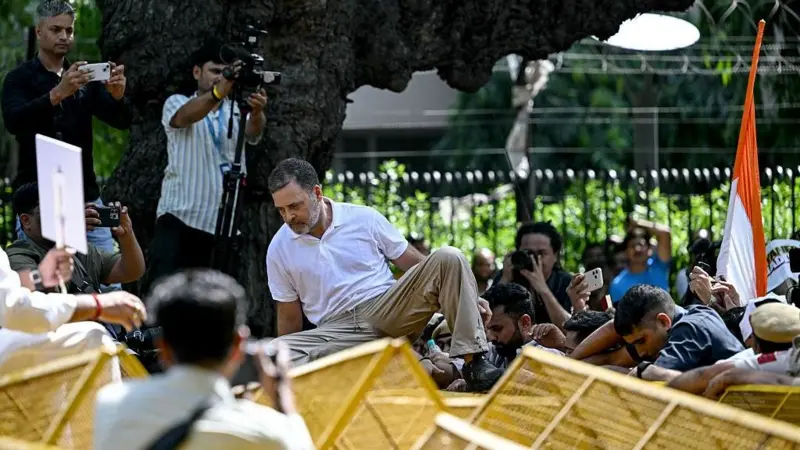
India is witnessing a noticeable change in the tone and style of political protest, with younger demonstrators increasingly using direct, confrontational and digitally driven forms of activism.
The latest wave of demonstrations has brought together established opposition parties, student groups and newer youth-led political movements. At the centre of the current protests are disagreements over the Special Intensive Revision (SIR) of electoral rolls and demands from opposition parties for the resignation of Chief Election Commissioner Gyanesh Kumar.
On October 6, opposition parties led by the Congress staged a major protest in New Delhi. Rahul Gandhi and Priyanka Gandhi Vadra were among those who participated, while several opposition MPs were detained after police stopped protesters from reaching the Election Commission headquarters.
The protests are not confined to Delhi. In Maharashtra, Shiv Sena (UBT) chief Uddhav Thackeray and MNS leader Raj Thackeray recently joined a large demonstration against the electoral-roll revision and demanded action against the Election Commission leadership.
But alongside established political parties, a distinctly younger political force has emerged: the Cockroach Janata Party (CJP), led by Abhijeet Dipke.
From satire to street politics The CJP began as a youth-oriented, satirical political movement and gained national attention during protests surrounding the NEET-UG examination controversy.
The controversy eventually became a major political issue. According to The Indian Express, the episode involved allegations surrounding a leaked examination paper, a satirical movement that became the CJP and, weeks later, the resignation of Union Education Minister Dharmendra Pradhan.
The movement subsequently expanded its focus beyond education.
In recent weeks, Dipke and his supporters have demanded the resignation of Chief Election Commissioner Gyanesh Kumar and challenged the Election Commission over the Special Intensive Revision of electoral rolls.
On October 2, hundreds of CJP supporters gathered in Mumbai despite police denying permission for the planned demonstration. Police subsequently registered a case against CJP leaders and more than 400 unidentified supporters, alleging unlawful assembly, traffic disruption and the use of loudspeakers without permission.
Reuters reported that the CJP's Mumbai mobilisation was part of a wider national campaign involving youth and student groups, with demonstrations planned in several cities.
Why is the language of protest becoming more aggressive?
The most striking change is not simply the number of young people appearing at demonstrations. It is the language they are using. Traditional Indian political protest has generally relied on speeches, slogans, party workers, marches and symbolic sit-ins. The newer style is more confrontational, irreverent and heavily influenced by social media culture.
Young activists often communicate through short videos, memes, satire, viral slogans and highly personal attacks on political leaders.
This can make their rhetoric sound considerably more aggressive than conventional opposition politics.
Dipke has repeatedly used provocative language while challenging senior government figures. His public statements against Home Minister Amit Shah and Prime Minister Narendra Modi have helped turn him into one of the most recognisable faces of this emerging youth movement.
The significance of this language is less about any individual slogan and more about what it represents: a younger political constituency that appears less constrained by the traditional rules of political communication.
SIR has transformed an administrative exercise into a political issue The electoral-roll controversy has provided the movement with an issue that extends beyond a single community or profession.
The Election Commission says the purpose of SIR is to ensure that no eligible citizen is excluded while ineligible entries are removed from electoral rolls. In May 2026, the Commission announced a nationwide phased exercise covering 16 states and three Union Territories, involving more than 36 crore electors in the third phase.
Opposition parties, however, have argued that the process could exclude legitimate voters and have questioned the manner in which electoral rolls are being revised.
The dispute has become particularly politically sensitive because the electoral roll determines who is able to exercise the most fundamental democratic right—the right to vote.
The Financial Times reported that opposition parties have alleged that millions of names were removed during the wider electoral-roll overhaul, while the Election Commission has argued that removals concern categories such as duplicate, deceased or migrated voters.
The disagreement has therefore moved beyond technical questions about voter lists and become a broader argument about democratic representation.
Why Gen Z matters India's younger population represents an enormous political constituency.
For many young Indians, the most immediate political concerns are not traditional ideological battles but education, examinations, employment, economic mobility, inflation, access to opportunities and political representation.
That helps explain why issues such as examination integrity can rapidly become political movements.
The NEET controversy demonstrated how an issue initially centred on students and examinations could develop into a national political crisis.
The subsequent emergence of the CJP suggests that some of the young people who participated in those protests are now attempting to transform street mobilisation into an organised political identity.
Women and the expansion of the protest base
Another important feature of India's current protest environment is the participation of women and people from urban middle- and lower-middle-class backgrounds.
Earlier major movements have often been associated with particular social or economic constituencies.
The farmers' protests, for example, were principally centred on agricultural communities and concerns over farm laws and market structures.
The protests against the Citizenship Amendment Act were driven largely by concerns about citizenship, constitutional rights and the treatment of minorities.
The current electoral and youth protests have the potential to reach a broader constituency because voting, education and employment affect citizens across caste, gender, occupation and regional boundaries.
That does not necessarily mean the movement has already achieved nationwide political unity. But it does mean that its issues can travel beyond a single social group.
Opposition parties are trying to connect with the same generation
The emergence of youth-led activism has also created an opportunity for India's opposition parties.
Congress leaders Rahul Gandhi and Priyanka Gandhi have increasingly participated directly in street protests. The October 6 demonstration in Delhi showed the opposition attempting to combine established political leadership with the energy of a younger protest movement.
Regional parties are also joining the campaign.
In Maharashtra, Uddhav Thackeray and Raj Thackeray appeared together at a major demonstration focused on electoral reforms and the SIR process.
The political calculation is straightforward: if young voters are becoming more politically active, every major party will want to speak their language. But there is also a risk.
Political parties that attempt to appropriate a youth movement without addressing its underlying concerns may struggle to maintain credibility. Gen Z activism is often decentralised, highly sceptical of traditional institutions and capable of moving rapidly between online and offline spaces.
The government's challenge
For the government, the emerging protest culture presents a different challenge from the movements of the past. Traditional political mobilisation can often be managed through negotiations with party leaders, community representatives or recognised organisations.
Digital-first youth movements are harder to control because there may be no single leader capable of negotiating on behalf of everyone involved.
The government's response has therefore become an important part of the political story. Police action, restrictions on demonstrations and the detention of protesters can sometimes contain a rally in the short term. But they can also generate additional attention online and reinforce the perception among young activists that the establishment is unwilling to engage with them.
The Mumbai case illustrates this tension. Police denied permission for the CJP's planned demonstration, but supporters gathered anyway, after which cases were registered over alleged violations.
Is India witnessing a new protest generation?
It would be premature to conclude that India is experiencing a permanent political realignment. Street protests do not automatically translate into votes, electoral victories or lasting political organisations. The CJP remains a relatively new political force, and opposition parties still face the challenge of converting public anger into a coherent political programme.
At the same time, the current developments should not be dismissed as simply another protest cycle. Something has clearly changed in the style of political participation.
Young Indians are increasingly comfortable challenging senior politicians, questioning institutions publicly and using humour, satire and confrontation as political tools. The result is a political environment in which the distance between a viral social-media post and a street demonstration can be extremely short.
The real test will come at the ballot box
The most important question is whether the current anger can survive beyond demonstrations.
India's next electoral cycles will provide the answer.
If concerns over electoral rolls, education, employment and political accountability translate into sustained youth participation, the current movement could become more than a series of protests.
If the mobilisation fades after individual controversies disappear, it may instead become another chapter in India's long history of periodic mass movements.
For now, however, one conclusion appears increasingly difficult to ignore:
India's younger generation is not simply joining the country's political conversation—it is changing the way that conversation is conducted.
And as political parties across the ideological spectrum compete for Gen Z's attention, the language of Indian protest may continue to become more direct, more digital and considerably harder for traditional political institutions to ignore.
- Reuters — Hundreds from India's Gen Z-led 'Cockroach' party protest
- Associated Press — India opposition parties rally for election chief's exit
- Indian Express — Rahul and Priyanka Gandhi protest against the Election Commission
- Indian Express — CJP protest and Gyanesh Kumar resignation demand
- Indian Express — NEET controversy and Dharmendra Pradhan's resignation
- Press Information Bureau — Election Commission's Special Intensive Revision, Phase III
- Indian Express — Uddhav and Raj Thackeray protest against SIR and CEC
Report a mistake
Related stories
Gujarat ATS Takes Salim Ismail Dola into Custody in ₹438-Crore Vadodara Drug Case
BMC Should Repost Dia Mirza’s Pollution-Free Diwali Video: Deputy Mayor Sanjay Ghadi
Gujarat CM Bhupendra Patel Inaugurates ₹48.22-Crore Modern Hospital in Vapi
Reader comments (0)
No comments yet. Be the first.