India Unveils FWD Supreme AI Combat Aircraft Prototype; First Flight Still Ahead
Bengaluru-based Flying Wedge Defence & Aerospace has unveiled its FWD Supreme AI combat aircraft prototype, designed for autonomous flight, a range above 1,500 km and a payload of around 350 kg. Flight testing remains a key milestone.

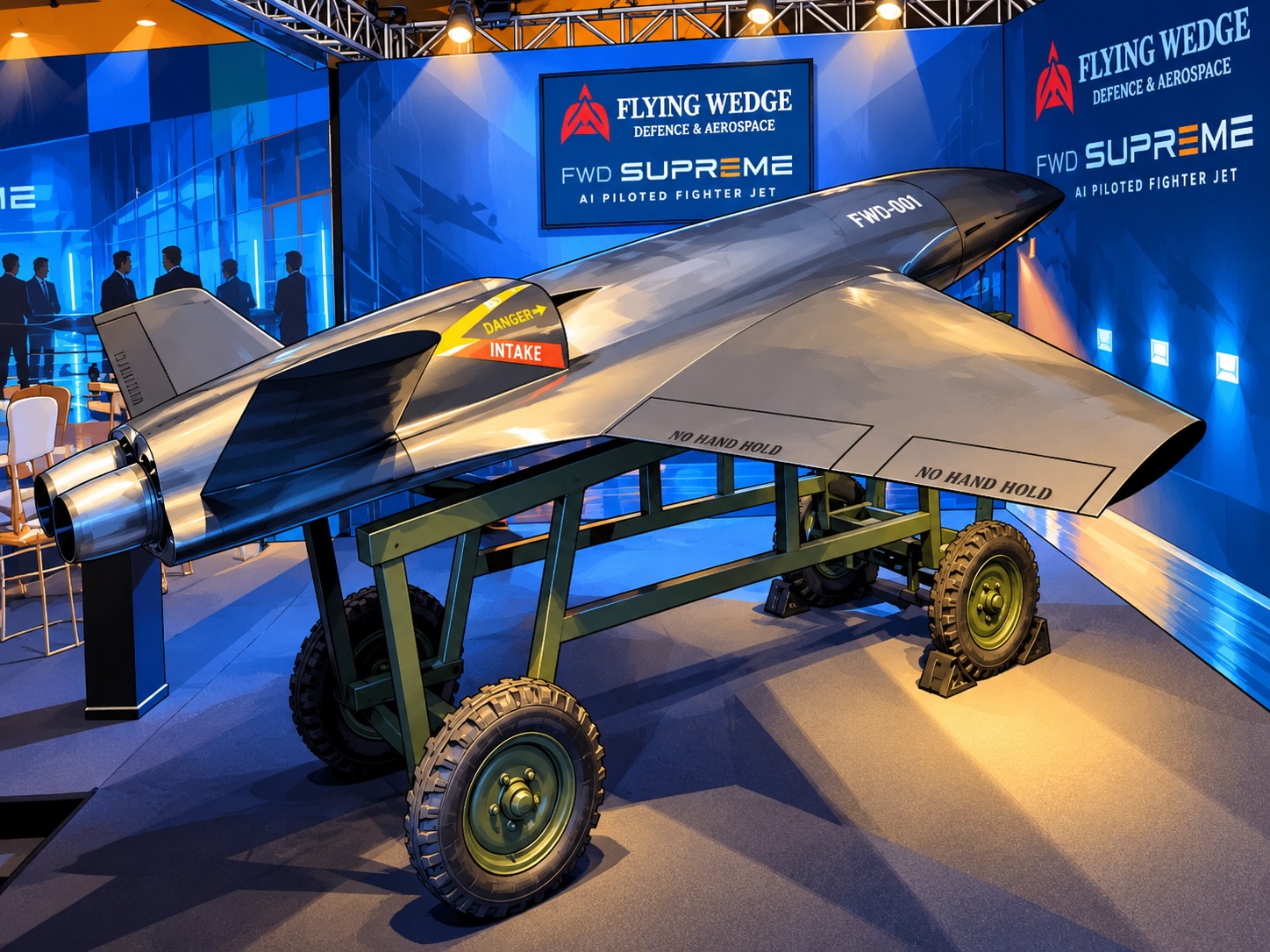
India's defence technology sector has taken a new step towards autonomous combat aircraft with the unveiling of the FWD Supreme programme by Bengaluru-based Flying Wedge Defence & Aerospace (FWDA).
The company has presented a full-scale prototype of an aircraft designed to use artificial intelligence (AI) to fly and carry out missions with limited human control. The programme aims to develop an Indian-made combat aircraft that can operate without a pilot on board. The unveiling marks progress in the development programme, but it does not mean that the aircraft is ready for military service. The larger FWD Supreme platform still needs further development, system testing and flight trials before its proposed capabilities can be confirmed.
The project is part of a wider global move towards unmanned aircraft that can support military operations without putting a human pilot directly in danger.
What is FWD Supreme? Key features explained
FWD Supreme is being developed as a flying-wing combat aircraft. Unlike a traditional fighter jet, which carries a pilot in its cockpit, this aircraft is designed to fly autonomously using onboard computers, sensors and AI systems.
According to specifications shared by the company and reported by defence publications, the proposed aircraft has the following features:
Maximum planned speed : Mach 0.8–0.85 Around 80–85% of the speed of sound.
Planned range : Over 1,500 km The intended distance the aircraft can cover, subject to testing.
Planned payload : Around 350 kg The stated carrying capacity for mission equipment and potentially weapons.
Approximate dimensions 10 m × 10 m The proposed flying-wing design is roughly 10 metres long and 10 metres wide.
The aircraft is also being designed with an internal weapons bay, satellite communication and a propulsion system rated at approximately 5 kilonewtons (kN). Its planned cruising speed is around 500–600 km/h, with an endurance target of more than two hours. These are development targets reported for the programme, not independently verified performance results.
Can it carry out attacks across the border?
The proposed range and payload could support long-distance military missions if the aircraft achieves its design goals and is equipped and approved for the intended role.
However, the reported specifications alone do not prove that FWD Supreme can successfully strike targets in Pakistan or China. Actual operational capability would depend on flight performance, navigation, communication, weapons integration, accuracy, reliability and military clearance.
The programme should therefore be understood as a developing defence project, rather than an already operational combat aircraft.
FWD Supreme Lite: The smaller aircraft that must prove the technology
Before the larger aircraft can become operational, FWDA is developing a smaller version called FWD Supreme Lite.
FWD Supreme Lite Technology demonstrator
-Weight category: approximately 250 kg
Reported domestic content: 90%
Engine: Indian-made, supplied by UMS of Coimbatore
Status: Taxi trials completed; first flight being prepared, according to the company.
Taxi trials involve moving an aircraft along the ground to check steering, braking, engine response and other systems before flight. Completing these tests is an important step, but it does not prove that an aircraft can fly safely.
FWDA has said that the Lite version will also help test technology needed for the larger FWD Supreme programme. Its first flight and subsequent flight tests will provide important evidence about how the design performs in real conditions.
India plans to reduce dependence on foreign engines FWDA says it is considering the integration of the DRDO-developed Manik small turbofan engine into the larger aircraft programme.
An engine is one of the most important and difficult parts of an aircraft to develop. It must provide enough thrust while meeting requirements for reliability, fuel use, temperature and weight.
Using an Indian-developed engine could help reduce dependence on foreign suppliers. However, the proposed integration must still be technically validated. Publicly available information does not establish that the Manik engine has already been integrated into FWD Supreme or that it meets all the aircraft's final requirements.
How will artificial intelligence control the aircraft?
Traditional remotely piloted drones are controlled by human operators from another location. An autonomous aircraft is designed to perform more tasks on its own using computers, sensors and software.
In simple terms, AI can help an aircraft: - Understand its surroundings: Use sensor data to identify objects and changes around it. - Navigate: Follow a planned route and maintain awareness of its position. - Respond to changes: Adjust its actions when conditions change, within its programmed limits. - - Work with other aircraft: Share information and coordinate tasks with other aircraft in a group.
These are the kinds of functions being developed across the autonomous aviation industry. The exact level of autonomy achieved by FWD Supreme will need to be demonstrated through testing.
What is the company's 'Mobbing Doctrine'?
FWDA describes its approach as the Mobbing Doctrine. The idea is that several AI-controlled aircraft could work together rather than operate individually.
For example, a group of aircraft could share information and coordinate different roles during a mission. Some could gather information while others support the wider operation.
The company presents this as a way to make military operations more flexible and potentially reduce the cost of using advanced aircraft. But coordinating several autonomous aircraft reliably is technically difficult. Their communication, decision-making and ability to respond safely to unexpected events must be tested.
The doctrine is a proposed operating concept, not proof that the aircraft can already carry out coordinated combat missions.
How does FWD Supreme fit into India's defence plans? India is already developing other unmanned combat aircraft technologies. DRDO's SWiFT demonstrator, for example, completed its first flight in July 2022 as part of work on stealth unmanned combat aircraft technology. This shows that the country's wider effort to develop unmanned military aviation did not begin with FWD Supreme.
The FWD Supreme programme represents a separate industry-led effort to develop an AI-enabled aircraft family. Its success could help expand India's domestic defence manufacturing and engineering capabilities.
However, several major milestones remain: 1. Complete the first flight of the smaller demonstrator. 2. Test flight stability, navigation and propulsion. 3. Validate autonomous control and communication systems. 4. Integrate and test the required mission equipment. 5. Complete the necessary military safety, evaluation and approval processes.
Only after the relevant testing and approvals can the aircraft's readiness for military use be assessed.
What does this development mean for ordinary Indians?
The project highlights the growing role of AI in defence, aerospace engineering and advanced manufacturing. It also shows why building a prototype is only one stage in creating a useful technology.
If the programme succeeds, it could create opportunities for Indian engineers, software developers, electronics manufacturers and aerospace suppliers. It could also help develop skills that may be useful in other fields, including robotics, navigation and industrial automation.
At the same time, autonomous weapons raise important questions about human control, safety and responsibility for decisions made by AI systems. These issues will matter as India and other countries develop increasingly independent military aircraft.
The key takeaway: FWD Supreme is an ambitious Indian defence project, but its proposed speed, range, payload and AI capabilities must not be confused with proven operational performance. The next major milestone is successful flight testing.
- The Economic Times — Flying Wedge unveils the FWD Supreme AI-piloted fighter programme
- The Economic Times — FWD Supreme Lite technology demonstrator
- Outlook India — India enters the AI-piloted combat aircraft race
- The Week — What makes FWD Supreme a potential development in AI combat aviation?
- DRDO — Propulsion technologies
Report a mistake
Related stories

Gujarat ATS Takes Salim Ismail Dola into Custody in ₹438-Crore Vadodara Drug Case

BMC Should Repost Dia Mirza’s Pollution-Free Diwali Video: Deputy Mayor Sanjay Ghadi

Gujarat CM Bhupendra Patel Inaugurates ₹48.22-Crore Modern Hospital in Vapi

Reader comments (0)
No comments yet. Be the first.