HAL Delivers Its 2,000th Aero-Engine: From ‘Shakti’ to ‘Aravali’, India Builds a Roadmap to Engine Self-Reliance
The delivery of HAL’s 2,000th aero-engine and a new ₹218-crore Shakti engine production line mark another step in India’s long effort to reduce dependence on foreign aircraft and helicopter engines.

India has built fighter aircraft, helicopters, missiles and satellites, but one area has remained particularly difficult: the engine. An aircraft can be designed and assembled in India, but developing the engine that powers it requires some of the most advanced engineering in the world. It involves high temperatures, extreme pressure, precision manufacturing and materials that must continue working reliably under enormous stress.
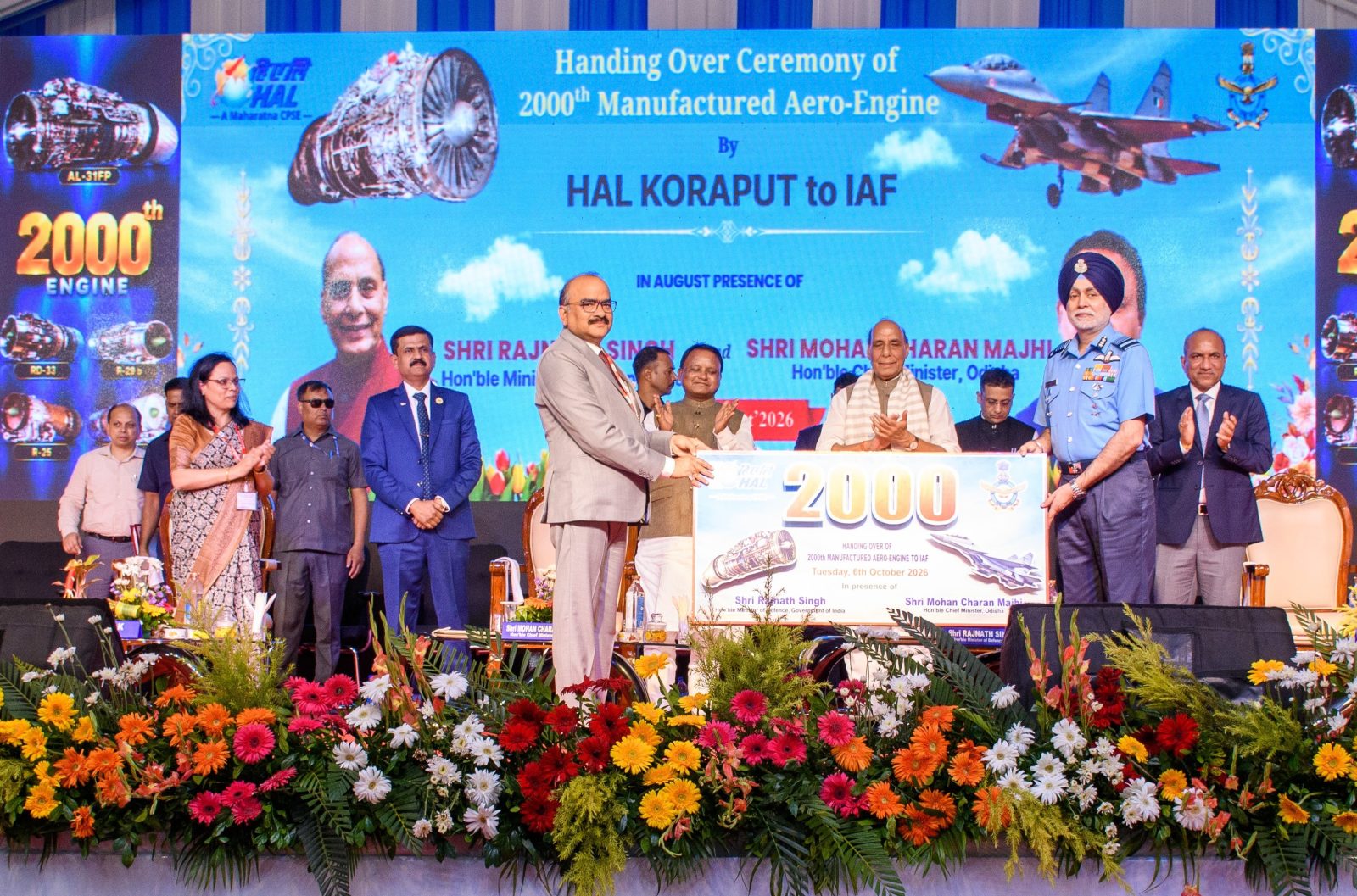
That is why the latest milestone at Hindustan Aeronautics Limited (HAL) is important. HAL's Koraput division in Odisha has delivered its 2,000th aero-engine, marking a major milestone in India's decades-long journey in aircraft and helicopter propulsion.
Defence Minister Rajnath Singh attended the event and said the achievement should not be seen simply as a numerical milestone. According to the Ministry of Defence, he described it as a contribution to India's aerospace journey and the operational capability of the armed forces.
But the bigger story is what comes next. India is now trying to move from manufacturing and overhauling engines under technology arrangements towards developing, producing and supporting increasingly sophisticated engines within the country.
Why is an aero-engine such a big deal?
To understand the significance, consider a simple example.
An aircraft engine is not like the engine of a normal car.
A modern fighter or helicopter engine has to operate at extremely high temperatures and speeds while producing large amounts of power without failing. Even a small manufacturing error can have serious consequences.
The most difficult part is not simply making the engine. It is mastering the entire technology chain—design, metallurgy, special alloys, precision components, testing, maintenance and long-term reliability.
Only a limited number of countries have developed advanced aircraft-engine capabilities at scale. That is why India's push for engine self-reliance is strategically important.
A country may be able to buy an aircraft from another nation, but if its engine technology, critical components or spare parts remain dependent on foreign suppliers, its strategic autonomy remains limited.
The 2,000-engine milestone
HAL's Koraput division was established in 1964 and has become one of India's important centres for aircraft-engine production, repair and overhaul.
Over the decades, engines associated with aircraft such as the MiG-21, MiG-27, MiG-29 and Su-30MKI have passed through the facility. The 2,000th engine therefore represents decades of accumulated engineering experience.
But the real significance lies in how HAL plans to use that experience to increase production and develop the next generation of propulsion systems.
New Shakti production line
One of the most important announcements at Koraput was the opening of a second production line for the Shakti helicopter engine. The new facility involves an investment of approximately ₹218 crore.
The Shakti engine is particularly important because it powers several Indian-designed helicopters.
These include the Advanced Light Helicopter (ALH) Dhruv, its armed variants such as Rudra, and the Light Combat Helicopter (LCH) Prachand.
The engine is based on the Safran Ardiden 1H1 design and has been developed through cooperation between HAL and France's Safran.
This distinction is important.
The Shakti is not a completely Indian-origin engine designed from scratch. It represents an important stage in India's evolution—from licensed production and technology cooperation towards greater indigenous capability.
The new production line is expected to increase India's ability to manufacture these engines domestically and support the growing fleet of indigenous helicopters.
From Shakti to Aravali
The next step is even more ambitious. HAL and Safran have created a 50:50 joint venture to develop a new high-power helicopter engine known as Aravali. The planned engine falls in the 3,500–4,000 shaft-horsepower class.
In simple terms, this is a significantly more powerful engine aimed at future heavy and medium military helicopters.
The engine is being developed for future platforms including the Indian Multi-Role Helicopter (IMRH) and the Indian Navy's Deck-Based Multi-Role Helicopter (DBMRH).
This is strategically important because India currently depends heavily on foreign technology for many high-power helicopter engines.
If the Aravali programme progresses as planned, it could help create a domestic capability not only to manufacture engines but also to design and develop them jointly for India's future military requirements.
The indigenous HTSE-1200 project
At the same time, India is pursuing another path: developing an engine without relying on a foreign design.
HAL's Aero Engine Research and Development Centre (AERDC) is working on the HTSE-1200, a turboshaft engine intended for helicopters in the approximately 3.5–6.5 tonne class.
This is significant because the HTSE-1200 is intended to be an Indian-designed engine.
The project demonstrates that India's engine strategy has several tracks:
- improve existing production capabilities; - develop engines through international partnerships; - absorb and build domestic manufacturing expertise; - and eventually create completely indigenous engine designs.
That is a much more realistic path towards self-reliance than trying to develop every technology independently from day one.
Su-30MKI engine production is also being expanded
The Koraput facility is not focusing only on helicopters.
HAL is also increasing production of the AL-31FP engine used by India's Su-30MKI fighter fleet.
The Indian government placed an order with HAL for 240 AL-31FP engines in 2024.
According to the Defence Ministry, HAL has delivered 63 engines by the end of the second year against a target of 60. That performance is significant because aircraft-engine production involves complex global supply chains and specialised raw materials.
HAL now plans to increase annual production of the AL-31FP from 30 engines to 50 engines.
The expansion involves an investment of approximately ₹335 crore.
For the Indian Air Force, this matters because the Su-30MKI is one of the most important aircraft in India's fighter fleet.
A stronger domestic engine production and overhaul capability can reduce dependence on overseas supply chains and improve the availability of spare engines.
The hidden challenge: raw materials
There is, however, an important part of the engine story that often receives less attention.
Making an engine is not enough. India also needs to make the materials that go inside it.
Modern aero-engines require highly specialised alloys and components that can withstand enormous heat, pressure and mechanical stress.
For this reason, the Defence Ministry has highlighted efforts to increase the domestic availability of specialised materials and components.
HAL's cooperation with Mishra Dhatu Nigam Limited (MIDHANI) is part of this broader effort.
The goal is to build a supply chain in which critical materials and components are increasingly available from Indian manufacturers. This is where the idea of "Atmanirbhar Bharat" becomes much more meaningful.
True self-reliance does not mean simply assembling an engine in an Indian factory.
It means developing the ability to design it, make its critical components, source its materials, test it, repair it and upgrade it.
Why engine technology matters for India's military future
India is rapidly expanding its indigenous defence manufacturing base.
The country now produces a growing range of military equipment, including the Tejas fighter, helicopters, artillery systems, missiles, warships and drones.
But propulsion remains one of the biggest technological challenges.
For example, India's indigenous fighter programme has long faced questions about engine availability and technology.
The experience has shown that developing a modern aero-engine can take decades.
That is why the Shakti, Aravali, HTSE-1200 and AL-31FP programmes should not be viewed as separate projects.
Together, they represent different steps in building an Indian aerospace-engine ecosystem.
From importing technology to creating technology
India's aerospace history has followed a gradual path.
The early years involved licensed production and maintenance of foreign aircraft and engines.
Over time, Indian engineers developed greater capability in manufacturing, repair and overhaul.
International partnerships then provided access to advanced technology and helped Indian companies develop modern manufacturing skills.
The next challenge is to convert that experience into indigenous design capability.
That transition is much harder.
Manufacturing an existing engine is different from designing an engine from the beginning.
Design requires knowledge of aerodynamics, combustion, materials science, thermal management, mechanical engineering, electronics and advanced testing.
It also requires years of testing before an engine can be trusted to power a military aircraft or helicopter.
The ₹5,000-crore question
Rajnath Singh has also pointed towards a much larger investment push in India's aero-engine capabilities.
The government's broader objective is to create an ecosystem capable of supporting advanced propulsion technologies rather than depending on individual projects.
The investment is important, but money alone will not solve the problem.
India will need:
long-term research funding, specialised engineers, advanced testing facilities, private-sector participation, reliable supply chains and sustained government orders.
Most importantly, the country will need patience.
A modern aircraft engine cannot be developed in a few years simply because additional money has been allocated.
The bigger picture
The delivery of the 2,000th engine is therefore best understood as a starting point rather than an endpoint.
India already has decades of experience in engine manufacturing, overhaul and maintenance.
The Shakti programme shows what international technology cooperation can achieve.
The Aravali programme represents a move towards joint development of a more powerful engine.
The HTSE-1200 represents the push towards indigenous design.
And the expansion of AL-31FP production strengthens India's ability to support one of its most important fighter fleets.
These programmes are not going to make India completely independent of foreign engine technology overnight.
But they can help build something more valuable: the industrial and technological foundation needed to eventually design and manufacture world-class aero-engines in India.
That is why the 2,000th engine matters.
The real target is not simply the next 10,000 engines.
It is the capability behind them—the ability for India to eventually decide what engine it wants, design it, manufacture it and keep it flying without depending entirely on another country.
- Ministry of Defence, Government of India — Defence Minister Rajnath Singh's remarks on HAL Koraput's 2,000th aero-engine milestone, Shakti engine production line and AL-31FP production expansion.
- Hindustan Aeronautics Limited (HAL) — Information on Koraput division, aero-engine manufacturing, overhaul and helicopter-engine programmes.
- HAL / Safran — Information on the Shakti engine and the HAL-Safran partnership.
- Government of India / Ministry of Defence — Information on the 240-engine AL-31FP contract for the Su-30MKI fleet.
- HAL Aero Engine Research and Development Centre (AERDC) — Information on the indigenous HTSE-1200 turboshaft engine programme.
- MIDHANI — Information on specialised materials and alloys used for India's aerospace and defence requirements.
Report a mistake
Related stories
Gujarat ATS Takes Salim Ismail Dola into Custody in ₹438-Crore Vadodara Drug Case

BMC Should Repost Dia Mirza’s Pollution-Free Diwali Video: Deputy Mayor Sanjay Ghadi
Gujarat CM Bhupendra Patel Inaugurates ₹48.22-Crore Modern Hospital in Vapi

Reader comments (0)
No comments yet. Be the first.